
Another slightly strange but amusing message from a periodicvideos viewer!
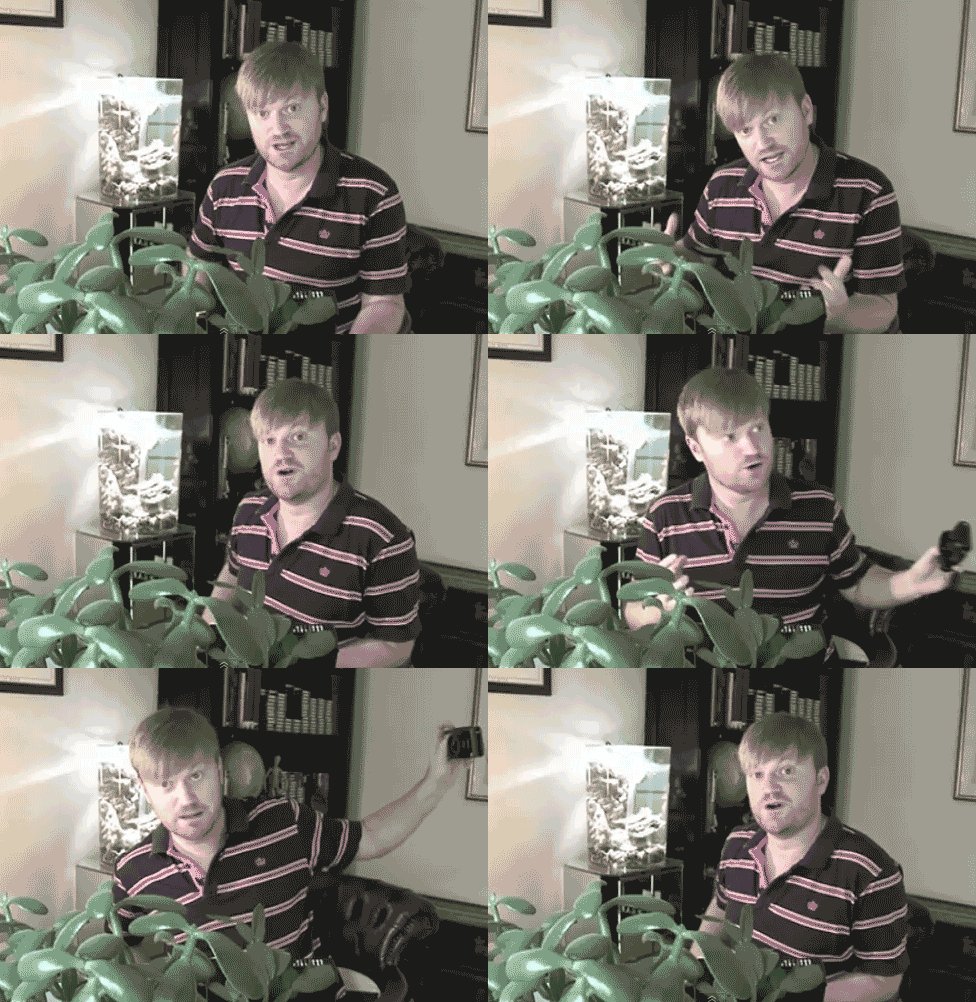
It is this animated GIF image, from a YouTube user called poorsoulja.
It came with the following explanation:
"I was scrubbing through your video and couldn't help but to capture the moment... Its a few frames of you, put together to look like cheesy stop-motion dancing (nothing vulgar)
"Silly, I know.... this is not what I spend all my time doing, btw. :)
"Your channels are excellent! Great work..."
Here's the video it came from:
Cheesy Dancing


Read User's Comments0

Some questions about Beryllium
Blogger Grrlscientist is currently posting blogs about the elements, using one of our videos each week.
Her recent post about Beryllium prompted a few questions from her readers.
You can see the post in question here.
We get asked dozens of questions every day and it's impossible to deal with all of them... But in this case I asked our experts to respond.
Here is what they said:
Professor Poliakoff wrote: "The question about the stability of atomic masses 4, 12, 16, is interesting and concerns an area miles away from my expertise, namely the synthesis or, if you prefer, birth of elements inside stars. The process which begins with H atoms and then involves fusion i.e. H2 + H2 --> He In the end the abundance of different isotopes depends on both the fusion reactions occurring in the stars and also on the relative stability of combinations of different numbers of protons and neutrons. The overall result is more complex than just multiples of 4. However, I don’t know enough to explain it further – even professors have their limits."
Dr Debbie Kays said: "There is a relatively low cosmic abundance of stable isotopes of Be (and also Li and B, actually) in the universe. The lack of 8Be is in contrast to other elements with atomic masses with multiples of 4 (such as 12C, 16O etc). 8Be is formed by helium burning reactions in stars but it is very unstable (with an extremely short half life). Although I’m not a nuclear physicist, it seems that 8Be is so unstable due to the fact that when it decays via alpha emission it produces two stable, self-contained 4He atoms which drives this decay process. In stars, the transient 8Be can also undergo a reaction with another 4He atom to form 12C, as LarryJayCee described, which can then undergo further reaction with another 4He to form 16O.
"The most stable isotope of beryllium is 9Be. This isotope is likely formed by fragmentation reactions in space, which can happen when high energy heavier elements in cosmic rays collide with the 1H or 4He atoms in cosmic gas and break apart.
"I didn’t know that there are speaker models out there which have beryllium in them! They seem to be pretty expensive from what I can see, this may well be due to the quality of the sound obtained from them, but also might due to the challenge of handling toxic beryllium reactants. I’m not sure of the advantages of having these speakers as I’m not a connoisseur of music but I assume that you can obtain higher frequencies with them due to the low molecular weight of beryllium."
Here is our Beryllium video:
A Lake of Pitch
Another great contribution from a periodicvideos viewer.
This one comes in response to an anecdote from The Professor.
In one of our videos about crude oil, The Prof casually mentioned a lake of oil in Trinidad.
Well, today I received an email from a viewer named Roy who has visited the so-called "Pitch Lake".
Roy said: "The professor mentioned Trinidad in the crude oil video. These two photos are from there - I hope he likes them.
"The lake is about 1 mile by 2 miles in size, and they have been taking (pitch) from this for years and it just keeps refilling."
Here are Roy's pictures:

And here's the video which prompted his email:
Chemical Inspiration
One of the best thing about projects like The Periodic Table of Videos is the idea that we're inspiring people to talk and think about science.
And luckily we see plenty of comments and emails to confirm this.
Here's a recent email that brought smiles to our faces:
"I just wanted to say Thank You to everyone at The Periodic Table of Videos. I saw your video on YouTube about the 'Chemical Garden', and I had to tell my Chemistry Club teacher about it. He took my idea and we used it yesterday at our Chemistry Club meeting. Thank You for you're wonderful ideas because that was probably one of the best experiments that we have done at my school! :)"
And here's the video in question:
The Elements Song (our version)
 If chemistry has an "anthem" it must be The Elements by Tom Lehrer.
Since launching The Periodic Table of Videos, people have regularly emailed about the song (in case I hadn't heard of it!)
We've never referenced the song because so many people have already made video clips using Lehrer's tune and voice as soundtrack.
I couldn't see the point of just doing another one!
But recently I had some inspiration and came up with our own twist - use our scientists to sing it!
Well, they didn't really sing it - just mine the archives for them saying each element's name.
Here's the result.
At the time of writing, the scientists themselves haven't seen the film... I hope they like it?
Special credit to my friend Dave Cheeseman who was a massive help with the music and technical fine tuning. He made it work.
The Avid "video editing timeline" we created for the film is the picture atop this blog entry!
And of course thanks to Tom Lehrer... Our video is merely a tribute.
Making Neutrons and Giant Magnets
The Backstage Science project continues this week with the first videos from ISIS.
ISIS is a huge facility (and I mean huge) where they crash beams of protons into metal targets, producing neutrons.
Those neutrons are then used by scientists to probe materials at the atomic level.
Here's a video looking around the complex.
There's plenty more to come from ISIS... For example, here is just a little extra snippet discussing the powerful magnets used to steer the proton beam.
More from the Sun
 A couple of weeks ago I blogged two videos about solar science.
They were filmed with solar scientist Chris Davis as part of the Backstage Science project.
Well here are two more extra bits - including one I'm quite pleased with.
When filming with Chris I noticed some funny looking bits of paper on his desk... I asked what they were?
He explained them and I immediately said: "Well, let's make a film about them too!"
And here it is:
These unplanned little snippets are often the best!
And here are a few extra questions with Chris, covering solar stuff and science in general.
Like so many people, you'll see he identifies Sagan and Feynman as his favourite scientists!
Click here for the other two videos I have done with Chris.
Subscribe to:
Posts (Atom)